A flag came down. The lost cause did not.
The Lost Cause has never relied on truth. It has relied on strategy — on monuments, on textbooks, on flags planted where 80,000 cars pass every day. A South Carolina court just ordered one of those flags down. The reason tells you everything about how hard this fight actually is.


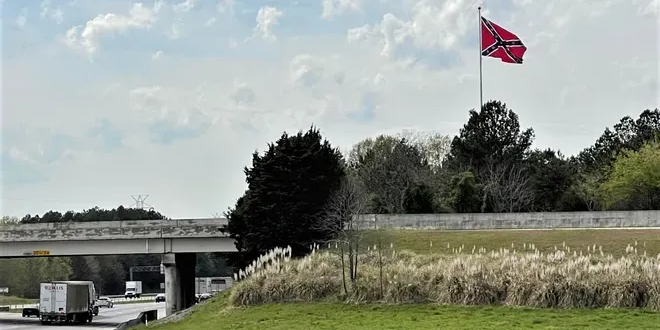
A 120-foot flag and a 30-foot limit
Last month, a South Carolina court did something unremarkable and, in the current climate, almost startling: it enforced the law.
A Sons of Confederate Veterans (SCV) chapter had erected a 120-foot flagpole along Teaberry Road in Spartanburg County. The massive flag towered next to a busy section of Interstate 85. However, they erected it without obtaining the required development permit.
Spartanburg County issued a violation notice. The group appealed. A zoning board initially sided with them. The county appealed that. A circuit court reversed the zoning board's decision. The group filed a motion to reconsider. Circuit Court Judge J. Mark Hayes denied it on January 29, 2026, and ordered the flag down before February 5. The flag came down.
The case will continue because of course it will. The group has appealed the ruling to the South Carolina Court of Appeals, but for now, the flag stays down.
Who put the flag there
The Adam Washington Ballenger Camp No. 68 of the SCV originally erected this flag. It is one of the oldest SCV chapters in the country, originally chartered in 1898 in Spartanburg.
The SCV itself was founded in Richmond in 1896 as a hereditary organization for male descendants of Confederate soldiers. It presents itself as a historical and preservation society—marking soldiers' graves, conducting reenactments, promoting what it calls "the true history" of the Civil War era.
That word "true" is doing an enormous amount of work, and it's worth re-examining what it actually means here: the Lost Cause.
The familiar mythology behind the monuments
The Lost Cause is not simply a romanticized view of the antebellum South. It is a deliberate and organized propaganda campaign that began almost immediately after Appomattox. Since then, it has never fully stopped. And we still feel the repercussions as a nation today.
Its central claims are straightforward, and reactionary politicians have trotted them out at every opportunity since. Behold the mistruths, again:
- The Civil War was fought over states' rights rather than slavery
- Slavery was a benign or even beneficial institution
- Confederate soldiers and their generals (ahem) were men of extraordinary honor who were simply outgunned by a more industrialized North
- Reconstruction was a period of unjust Northern revenge rather than a promising, if incomplete, attempt to build a multiracial democracy
Every one of these claims of course is absolute bullshit.
We this know this not just from contemporary scholarship but from the words of the Confederates themselves. Alexander Stephens, the Confederate Vice President, said plainly in his 1861 Cornerstone Speech that the Confederacy's foundations were built upon "the great truth that the negro is not equal to the white man." The secession ordinances of South Carolina, Texas, Georgia, and Mississippi all explicitly named the preservation of slavery as their cause.
The historical record is not ambiguous. As much as they whine otherwise.
The Lost Cause became the philosophical foundation for the racial violence and terrorism employed to reverse Reconstruction and for the reimposition of white supremacy in the Jim Crow era. Its acceptance in the North as well as in the South facilitated national reunion following the war—but at the cost of the civil rights of African Americans. Historian David Blight put it concisely: a key to the Lost Cause is "its use of white supremacy as both means and ends."
The monument-building campaigns of the late 19th and early 20th centuries were not acts of grief. They were acts of power. The Lost Cause reached a high level of popularity again during the civil rights movement of the 1950s and 1960s in reaction to growing public support for racial equality.
Lost Cause organizations built monuments and rewrote history textbooks not only to entrench their version of the Civil War in public memory but also to sustain the white supremacist policies, like Jim Crow, that depended on it. Georgia redesigned its state flag in 1956 to include the Confederate battle flag (and what a battle it was to get it changed). South Carolina hoisted the battle flag above its statehouse in 1961—ostensibly to mark the war's centennial, but also in direct response to the Freedom Riders and the sit-in movement.
These are not coincidences.
The United Daughters of the Confederacy ensured that every white classroom in the South had a Confederate battle flag for display (my own high school, Riverheads, did not), reviewing school textbooks to ensure they represented the Confederate cause as honorable and just.
They also printed "catechisms" for the Children of the Confederacy—booklets with questions and answers for white children to memorize—instructing them how "Reconstruction was unjust to the South" and that only the actions of the Ku Klux Klan "saved" the South from "negro domination."
This is actual blasphemy. An actual church catechism reads thusly (I memorized this as a kid):
Q. What is the sum of the six commandments which contain our duty to man?
A. The sum of the six commandments which contain our duty to man, is, to love our neighbour as ourselves, and to do to others what we would have them to do to us.
These are not the practices of a historical society. They are the practices of an indoctrination program.
Recent scholarship has confirmed a statistically significant correlation between the number of lynchings in a county and the number of Confederate monuments it contains. Courthouse lawns were common sites for both monument dedications and lynchings. Not coincidentally, both served the same purpose: the enforcement of white supremacy through public spectacle.
When the Stonewall Brigade commander in Fairfield (just down the road) talks about bringing monuments "home," when Camp 68 in Spartanburg invokes the Battle of the Crater, when the SCV national website describes its mission as preserving "the true history of the 1861–1865 period"—this is the tradition they are operating within. The heritage they are defending is not the heritage of fallen soldiers. It is the heritage of the propaganda machine built to ensure those soldiers' cause outlived their defeat. It is the heritage of outright racism and chattel slavery.
Black voices have been speaking this truth
Black voices have called this out for over a century, and they have been ignored. In 1890, Richmond journalist John Mitchell Jr. wrote that white Southern memorialization of the Confederacy "serves to retard [the South's] progress in the country and forges heavier chains with which to be bound."
W.E.B. Du Bois spent decades critiquing the cultural veneration of Lee and Davis as symptoms of deeper social pathology. Mary Church Terrell directly challenged Lost Cause theories of race in 1904.
Carter G. Woodson and Rayford Logan wrote searching histories of Black life before and after slavery that exposed the mythology's false narrative.
These were not fringe voices. They were among the most rigorous public intellectuals of their era—and the power of white supremacist cultural institutions ensured they were ignored while Lost Cause textbooks shaped generations of classrooms. Fiend of Not Unmindful, Ty Seidule describes this in his book: Robert E. Lee and Me.
These critics were not wrong then. They are not wrong now. The difference? Today their arguments have the full weight of mainstream historical scholarship behind them. The Lost Cause has no credibility left in any serious academic or archival setting. It survives, as it always has, not because it is true, but because it is useful.
But the Lost Cause has the current political power behind it, again.
Closer to home
For us, this isn't abstract. We see it coming back or living there. In May 2023, the Stonewall Brigade camp of the SCV—the local camp of the same organization—dedicated what they're calling Lee-Jackson Memorial Park on a two-acre site along the southbound exit of Interstate 81 at Fairfield.
To the sound of bagpipes playing "The Bonnie Blue Flag," they raised a large Confederate battle flag visible to every driver heading south through Rockbridge County. (No link for the racist source is my editorial decision.)
The park is explicitly designed as a sanctuary for displaced Confederate iconography—a place to receive monuments removed from Southern cities and commission new ones. The camp commander described it as coming in from "the wilderness," a refuge from what he called the forces trying to drive Confederate heritage from the public square. One of the major donors called the site "the promised land" and issued a call for Charlottesville to return its removed statues of Robert E. Lee and Stonewall Jackson to the park. They need their gods.
Nevermind that neither general has any connection to Fairfield, but to Lexington. Lexington did the right thing already.
Unlike the Spartanburg situation, the Fairfield flagpole appears to have been legally permitted—the camp obtained a building permit from Rockbridge County for the 80-foot pole, and the property falls outside the county's tourism corridor overlay district, exempting it from additional zoning review. Of course tourists don't travel I-81... a fucking joke.
That distinction matters. The Spartanburg case was won on a procedural technicality. The Fairfield project did its homework. It found land in a regulatory gap, secured the right paperwork, and built something designed to be permanent.
When asked how he would respond to those who view Confederate monuments as symbols of white supremacy, the Stonewall Brigade commander said his answer had grown "quite cynical"—that those who oppose Confederate heritage have "had no issue with destroying things that we love," and that the park was a way to reestablish SCV presence "just beyond their control." So boo fucking hoo, now come and get it.
That's a frank statement of intent. This is not preservation in any archival or scholarly sense. It is defiance, organized and land-banked: a new iteration of a strategy that goes back 160 years: find a venue, claim it, and dare the public to respond and subtly threaten them if they do.
It's the heritage without hate argument, even when the heritage IS hate. Not to mention the whataboutism. And the pry my cold dead hands thing on top as a ribbon.
The Rev. Reginald Early, president of the Rockbridge County NAACP, put it plainly in response to the Fairfield project:
"There are forces in the American society as well as the local community who want to dismiss people of color and all of their contributions. Those forces are working tirelessly to take us backwards rather than forward."
So the law, as it stands locally in both instances, was followed. The flag stays up or goes down. But it might be time to change those laws across the board so there is no ambiguity or loopholes to finally punish the traitors and those that worship them because of their white supremacy complex.
What the law did and did not do
The neo-Confederates have long wrapped themselves in the language of heritage and free speech, making any challenge feel like cultural overreach. That framing has been remarkably effective because poor whites are aggrieved and politicians respond or echo it. They are a reliable audience for it, and politicians know it.
While the communal grief white Confederate Southerners suffered from the war and the loss of their evil empire may well have been very real, it became an instrument of defiance and exploitation. It created an ideology that justified segregation and white supremacy.
The broader battle over Confederate symbols in public life has been fought and refought for decades, with some genuine progress. South Carolina removed the Confederate battle flag from its Statehouse grounds in 2015, following the massacre at Mother Emanuel AME Church. Georgia changed it's flag. Lexington banned the traitor's flag in public spaces.
But that progress has always been contested and often fragile. No matter how discredited, no matter how much mainstream historical scholarship and teaching curricula expose and explain the Lost Cause traditions, they endure—especially for those in search of a past that they believe will relieve them of the present. Or even scarier, that they can somehow recreate.
In a political moment when DEI programs are being gutted, diversity initiatives dismantled, and the interpretation of American history is again under siege in classrooms and statehouses, a court order enforcing a zoning ordinance in Spartanburg County is a small, procedural thing. But it is a thing. The flag came down. And in Fairfield, it didn't. The law worked in one place, and had nothing to say in another. That's not an argument for despair it's an argument for clarity.
We know what the Lost Cause actually is. WE know the history. We know its aims. We must do what ever we can do wherever we can do it, and keep moving forward...
Non in cautus futuri (not in memoria praeteritorum bonorum).