From the Confederacy to the Pentagon
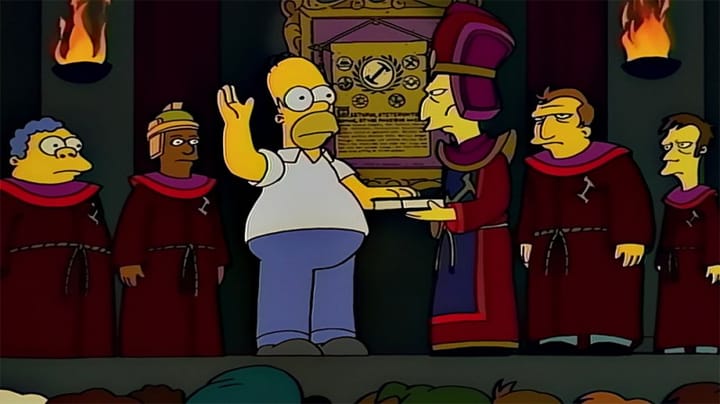
Pete Hegseth has turned the Pentagon into a sanctuary for Christian nationalism—and the theology of his mentor, Lost Cause apologist Doug Wilson, is now shaping how commanders explain an actual war, despite their protestations.



God of war
There is a man tattooed with the Jerusalem Cross—the coat of arms of the Crusader Kingdom of Jerusalem after 1099—who now controls the most powerful military in the history of the world. He has renamed his department the Department of War. He hosts monthly Christian prayer services inside the Pentagon. He attends weekly White House Bible studies. He told the National Prayer Breakfast in February that America:
"...was founded as a Christian nation. It remains a Christian nation in our DNA if we can keep it. And as public officials, we have a sacred duty 250 years on to glorify Him."
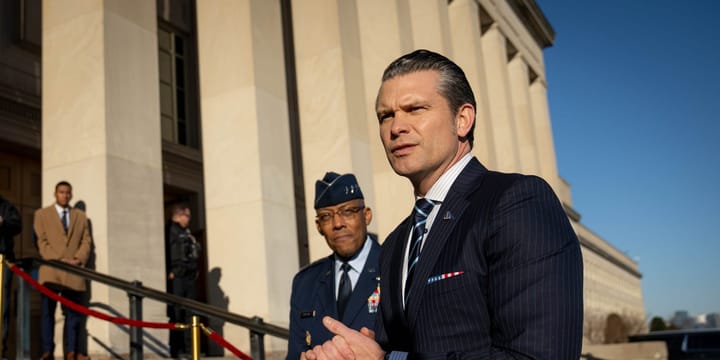
Ladies and gentlemen meet Pete Hegseth, the United States Secretary of Defense.
While all this may seem like background noise, it's not. This is their operating system.
The pastor and the Pentagon
On February 18, Hegseth invited Doug Wilson to lead the Pentagon's monthly prayer service. Wilson is a pastor from Moscow, Idaho. He describes himself as a Christian nationalist and is the co-founder of the Communion of Reformed Evangelical Churches. Hegseth belongs to this "denomination."
The Secretary did not only invite Wilson, but he also thanked him, on stage, in front of hundreds of troops and government employees, for his "leadership" and "mentorship" and "the willingness to be bold." He called Wilson's presence an exercise in the kind of thing "we are trying to do here."
Wilson told the crowd the service was a sign of national revival. "If you bear the name of Jesus Christ," he declared, "there's no armor greater than that."
The Department of Defense—operating under a name its secretary has no legal authority to change—posted photographs of the two men together on its official communications channels with the caption: "We are One Nation Under God."
Let's be clear about who Doug Wilson is, because the Pentagon's embrace of him deserves more than the three-paragraph treatment it's received in most outlets.
Wilson has written that enslaved people in the American South had an "affectionate" relationship with their owners. Rape is not affectionate. He has argued that women are unsuited for combat because God assigns gender roles. His church holds that women should not vote. When The Military Times asked him about whether he supports the 19th Amendment, Wilson declined to give a straight answer. Instead he retreated to language about how his church runs its own elections.
Now get this! He believes, and has taught, that the Civil War was biblically justified. He has argued that Muslims have no right to participate in government and has made statements about LGBTQ people that are too toxic to dignify with repetition here.
Wilson's reverence for the Confederacy is not incidental to his theology—it is load-bearing. He has written extensively about Robert E. Lee with the devotion of a hagiographer. He frames the Confederate cause as a Christian civilization that understood the ordained nature of social and race hierarchy.
Lee, in Wilson's telling, was not a traitor. He was a model. Stop me if you've heard this one before. He was a Christian soldier who chose his people, bore his burden with honor, and trusted God's providence even in defeat. Stop me if you've heard this one before.
This is the Lost Cause not as regional nostalgia but as active theology—and it is the theology now being practiced inside the Pentagon. The rebels are running the establishment.
This is the man Pete Hegseth calls his mentor.
The new crusades in real time
It would be troubling enough if this remained a story about prayer services and ideological patronage. It has not remained that story.
The United States is currently waging war on Iran. Actual war. As of this writing, the U.S. has sunk a defenseless ship from the Iranian Navy in the Indian ocean. (The same ship had just completed maneuvers with the U.S. Navy at the behest of the Indian government. And seven American service members are dead. Six of them arrived at Dover Air Force Base in flag-draped cases last week. (Some of them had served for nearly two decades and the youngest was just 20 years old.)
More will follow. Boots on the ground and all.
And in the units preparing for possible deployment, some of the men and women responsible for those troops have been telling them what this war is really about.
The Military Religious Freedom Foundation, an organization founded by Air Force veteran Mikey Weinstein and made up of roughly 95% of Christians, has been flooded with complaints from service members. The pattern across those complaints is consistent and specific. Commanders describing the Iran conflict as biblically sanctioned, as the fulfillment of end-times prophecy, as the signal fire for the return of Christ. One commander reportedly told his unit that Trump "has been anointed by Jesus to light the signal fire in Iran to cause Armageddon."
What rough beast slouches toward Bethlehem indeed.
Thirty members of Congress, led by Reps. Jamie Raskin and Jared Huffman of the Congressional Freethought Caucus and House Armed Services Subcommittee Ranking Member Chrissy Houlahan, have formally requested that the DoD Inspector General investigate whether Hegseth's "extreme religious rhetoric has metastasized into segments of the military chain of command."
Metastasized. That is a word chosen carefully by members of Congress, and it is the right word. This is what happens when the person at the top of a command structure makes his theology the governing framework of his leadership. It is a cancer that flows downward. It fills the vacuum. It kills our polity.
And when young soldiers are frightened and uncertain and looking for meaning, a commander who tells them God has ordained this—that dying here is a path to salvation, as Hegseth himself suggested at the National Prayer Breakfast — is not offering comfort. He is issuing an order wrapped in scripture.
Religious war by a new name. The soldiers will still be dead, whatever their beliefs.
This isn't new. That's the point.
American military history has never been free of religion. Chaplains, prayer, the assumption of providential purpose—these are woven through the fabric of how this country has always gone to war. And when we think of the fight against global fascism in the '40s, it fit well.
None of that is what we're talking about here.
What we're talking about instead is the deliberate institutional capture of a secular military command structure by a specific theological movement. A movement with a specific political agenda, a specific theory of history, and a specific set of beliefs about who belongs in the American project and who does not. A specific racism and misogyny if you will.
Doug Wilson does not believe women should vote. He does not believe Muslims have a role in American governance. He has written sympathetically about the slaveholder's relationship with the enslaved. These are not fringe positions he holds privately. They are published, defended, and taught. This man is the spiritual mentor of the Secretary of Defense. And he is welcomed into the Pentagon and praised on government social media as an emblem of national identity.
The Lost Cause mythology as racist as it is does not exist in isolation. It is part of a coherent ideological framework that ranges from your local school board to the Idaho pastor. And now to the Pentagon war room. Wilson is an explicit link in that chain. His theology of hierarchy—racial, gendered, religious—springs directly from theology that gave the Confederacy its self-understanding; a Christian civilization defending a divinely ordained social order.
The statues of Robert E. Lee are coming down from courthouse squares across the South—against fierce resistance from the movement Wilson represents. But the ideology those statues were built to consecrate has not been defeated. It has been promoted. It now has a prayer service at the Department of Defense and the ear of the man who controls the American military.
You don't need the monument when you have the Pentagon.
That theology is now hosting prayer services inside the Department of Defense. It is now shaping how commanders explain a war to the troops under their command. It is now, per the Jerusalem Cross tattooed across the chest of the Secretary of Defense, decorating the body of the man with his finger on the most lethal apparatus in human history.
What the Establishment Clause was for
The Constitution is not ambiguous on this. The First Amendment begins with a prohibition: Congress shall make no law respecting an establishment of religion.
The framers—several of whom, it bears noting, were educated at William & Mary—understood from European history what happens when state power and religious authority fuse. They built a wall. Not because they were hostile to faith, but because they understood that the wall protects faith as much as it protects the state. A military that tells its soldiers they are fighting for Jesus is not protecting religious freedom. It is conscripting it.
Hegseth's response to this criticism has been to frame the prohibition itself as the attack. "Protecting our culture and our religion from godless ideologies and pagan religions," he said in a recent speech, "is not political—it is biblical." In other words, the Constitution's secular framework is the threat. His theology is the defense.
That is not only a confession but also a declaration.
Service members now are filing complaints with the MRFF. They are not doing so because they are hostile to religion. The MRFF is 95% Christian. They are doing so because they took an oath to a Constitution and they are being told, by the people commanding them, that the oath that matters is to their theology. A military contractor who declined to attend one of Hegseth's prayer services put it plainly:
"the services give Christians access to senior leadership that members of other faiths simply do not have."
This is not religious freedom. That is religious adherence enforced through the chain of command.
The bodies at Dover
Six soldiers came home to Dover last week. Seven are dead. The youngest was 20 years old.
They did not die for Jesus. They did not die to light a signal fire for Armageddon. They died because a government sent them into harm's way, and governments that do that owe those soldiers—and the rest of us—a reckoning:
Why this war? What are the objectives? What does victory look like? What is the plan?
No one has answered those questions. Instead, the commanders of some of the units preparing for expanded combat, offer eschatology. The war is God's will. The dying and blood shed fulfills a prophecy. But whose.
That is not a military rationale. It is a mechanism for silencing doubt, suppressing dissent, and insulating bad decisions from accountability. It is, in the oldest and most cynical sense, how power employs religion when it needs a justification for something it cannot defend on the merits.
Pete Hegseth wears the Jerusalem Cross. The Crusaders wore it too. Nazis saw themselves in the same light.
History has a verdict on the Crusades and fascists. It will also have one on this war.
We must plainly ask the reasons again and again, and then we must hold them to account.
Non in cautus futuri.
Further reading update 13 March 2026: CNN now has a deeper article about this but it misses the confederate, Lost Cause, racism background entirely.