Government of the people, for the people—white people
Since October, the U.S. has admitted 4,499 refugees. 4,496 were white South Africans. Meanwhile, Hegseth has purged Black and female officers from military leadership. This is one story, not two.


4,496 of 4,499.
The latter is the total number of refugees admitted to the United States since October 2025, according to the Refugee Processing Center. In the last full fiscal year of the Biden administration, the United States resettled 125,000 people from 85 countries: from war zones, from famine, from the specific and documented hell that produces a refugee.
Donald Trump shut that down on day one. Then he made an exception.
4,496 of that total were Afrikaners—white South Africans whom Trump has designated as victims of racial persecution. The other three were Afghans, whose admissions were later revoked. The administration's position stated plainly that the world's most deserving refugees are white farmers from a country at peace, and the U.S. refugee program exists to serve them. White Afrikaners.
South Africa's ambassador to the United States, Ebrahim Rasool, called this what it is. Trump, he said, was "mobilising a supremacism" and trying to "project white victimhood as a dog whistle." For that clarity, he was declared persona non grata and expelled from the U.S.
Keep that number in mind: 4,496 out of 4,499. And place it with what has been happening at the Pentagon at the same time.
The promotion list, again
The pattern at the Pentagon is by now documented. As covered here last week, Hegseth has systematically removed or blocked the promotions of Black and female senior officers across all four branches—Brown, Franchetti, Crosland, Green.
Most recently, Army Chief of Staff General Randy George was fired after refusing to remove Black and female officers from a promotion list. Hegseth declined even to meet with him to discuss it.
The Pentagon's official position is that promotions are "apolitical and unbiased." Hegseth's own chief of staff, Ricky Buria, offered a more candid assessment last year: "President Trump would not want to stand next to a Black female officer at military events."
Buria denied it. The firings continued.
An old argument returns in force
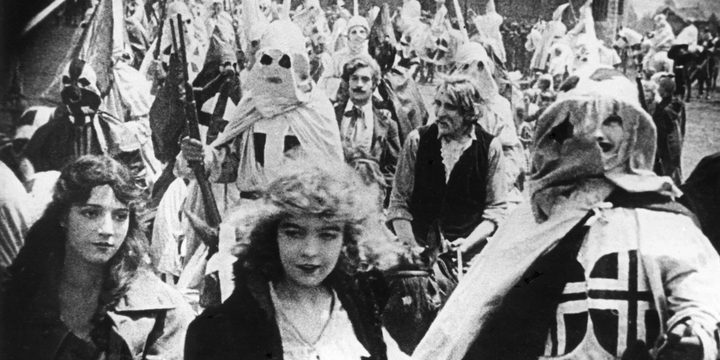
D.W. Griffith's The Birth of a Nation (the image above is from that film) came out in 1915. Woodrow Wilson screened it at the White House and called it "writing history with lightning." The film's argument, made with the full apparatus of early cinema, was this: Reconstruction was a catastrophe visited upon white people, Black political power was an existential threat to civilization, and white men riding to restore the racial order were heroes.
The argument it made has never really ceased. The Lost Cause spent the century and a half after Appomattox dressing it in bronze and marble—in the statues of Confederate generals in courthouse squares, in the names on military bases, in the textbooks that called enslaved people "workers" and the Civil War a dispute over "states' rights."
The argument is always the same: white people are the aggrieved party, their dominance is the natural order, its disruption is the injustice requiring remedy.
That argument is now refugee policy. It is now Pentagon personnel policy.
The Afrikaner farmers and the Black and female generals are different scenes in the same production.
In the first, white people displaced by the end of apartheid are cast as the world's most compelling victims, deserving of refuge that is denied to people fleeing actual wars.
In the other scene, Black and female officers who have spent careers in honorable service are removed from promotion lists because the Secretary of Defense has decided the warrior ethos belongs to a particular kind of person.
Hegseth has been explicit about this. He has complained that "America's white sons and daughters are walking away" from the military. He has said "our diversity is our strength" is "the dumbest phrase in military history." He has rehabilitated tributes to Confederate soldiers at the Pentagon. Yes, traitors. And he has been erasing the histories of nonwhite service members who fought for it.
The connections aren't subtle. It is, in fact, written on his skin.
Not a culture war but an imposition
This is not a culture war. Culture wars have two sides arguing about values. What we are watching is the institutional capture of federal power by an ideology with a very specific theory of who should have power in America—and who should not. That ideology has a long history in this country. It built the monuments. It wrote the textbooks. It made that movie.
It is now running the Pentagon and the refugee program.
Senator Raphael Warnock, senior pastor at MLK's own Ebenezer Baptist Church said as much in an exchange with Jake Tapper. He was explaining that faith leaders who claim divine sanction for this administration's actions are doing what religious leaders have always done when they sanctify power:
"Yeah, they're wrong. And there were Christians who thought that slavery was, you know, somehow Godlike, American chattel slavery. And they justified it, and they used scripture to support their position."
He is right about that. He is right about what this is.
The Birth of a Nation was fiction dressed as history. What is happening now is policy. The casting has changed. The argument is the same.
And now it's a documentary.
Update: April 26, 2026
The program is now expanding. The numbers above, already stark, are about to get starker.
According to Reuters, the administration is now discussing more than doubling the 7,500-person annual refugee cap by 10,000. This is specifically to accommodate additional Afrikaners. State Department documents show the U.S. has already paid to install trailers on embassy property in Pretoria to handle the processing load. They are targeting 4,500 applications per month. The new U.S. ambassador to South Africa is Leo Brent Bozell, a conservative media figure, which tells you something about the diplomatic priorities at play here.
That monthly target is jarring. Four thousand five hundred per month, from a country whose government denies the persecution narrative, whose white minority has been returning home from abroad in increasing numbers, and from which at least four of the original resettled refugees have already gone back.
Again, the refugee program was established in 1980 to help people fleeing wars in Vietnam and Cambodia. Trump has used it, almost exclusively, for this.
The policy has not changed. Neither has the logic behind it.
Non in cautus futuri.